Everest Base Camp With Gokyo lake Trek
USD 1,550 / Per Person
Trip Overview
The Gokyo to Everest Base Camp Trek, also known as the Mt. Everest (8848m) Circuit Trek, is one of the most popular treks in the Himalayas. The trek takes you along a route via the high altitude Cho La Pass (5,420m) to Everest Base Camp. The trek begins at Lukla and then to Phakding and Namche Bazaar. It then proceeds through several villages until arriving at Gokyo, Mt. Everest Base Camp, and finally to Kala Patthar (Black Rock) – a well-known viewpoint from where Everest is clearly visible.
The trail heads through many Sherpa villages along the route. The Sherpa people have a worldwide reputation for their high altitude climbing skills. The trail meanders through the Dudh Koshi Valley to its source at Gokyo Lake (4700m) located to the west of EBC. Another highlight of this trek is to summit Mt. Gokyo Ri (5,375m) from where you have some amazing views of Cho Oyo, Everest, Makalu and many more snow covered peaks. This region is inhabited by mostly Buddhists who follow the Tibetan Buddhist teachings. On the trek we will visit several famous monasteries and get to hear the enchanting prayer mantras.
The trails take you through gorges, lush forests and across mountains before you arrive at EBC. There will be plenty of time allocated to allow you to acclimatize before heading to higher altitudes. Passing through numerous villages in the Khumbu region will give you a first-hand look at what the villagers have to endure to survive in these rugged mountains, and also how their dutiful Tibetan Buddhist faith enriches and affects their lives.
The mountains appear so close that you feel that you can literally reach out to them! Four of the tallest mountains in the world are to be found in this area.
Sherpa Expedition & Trekking will arrange for all permits, meals and accommodation on the trail.
Everest Base Camp With Gokyo lake Trek Day-by-day ITINERARY
A Sherpa Teams representative will meet you at the airport and take you to your hotel in Thamel by private vehicle. Once you are checked in we will brief you on all aspects of the trek and answer any questions you may have concerning the trek. You will also be provided with a duffel bag and a sleeping bag. At this briefing, you will need to have your passport, three passport size photos and a copy of your travel insurance policy. This is also the time to clear up the balance owing for the trek. You can spend some time wandering around the winding and narrow streets of Thamel and maybe buy some things you need for the trek.
This morning we have a 30 minute early morning fight from Kathmandu domestic airport at Lukla. After landing at Tenzing-Hillary Airport we will prepare our packs for the trek. We then head out on the trail and descend down to the Dudh Kosi River where we join with the trail that leads to Namche Bazaar. The trek today is quite easy and not too physically demanding. We then pass through the small village of Ghat (2,550m) and then continue until we reach Phakding where we will stay overnight.
This morning we head to Namche Bazaar (3440m) the largest Sherpa village in Nepal. Prior to arriving at Namche Bazaar we pass through several small villages, such as Jorsale (2804m) and Monjo (2835m). Monjo is located just north of Phakding and is the entrance to the Sagarmatha National Park, a UNESCO World Heritage listed site. We will stay overnight in a guesthouse.
Today is spent acclimatizing before heading to higher altitudes. Altitude sickness can be minimized by stopping at lower altitudes and staying active - recommended by health professionals. We will take a short trek to a local museum that houses Sherpa artifacts and other cultural items, and also climb up to Syangboche Airport near the Everest View Hotel where the views of the Himalayas and Khumbu peaks will leave you stunned.
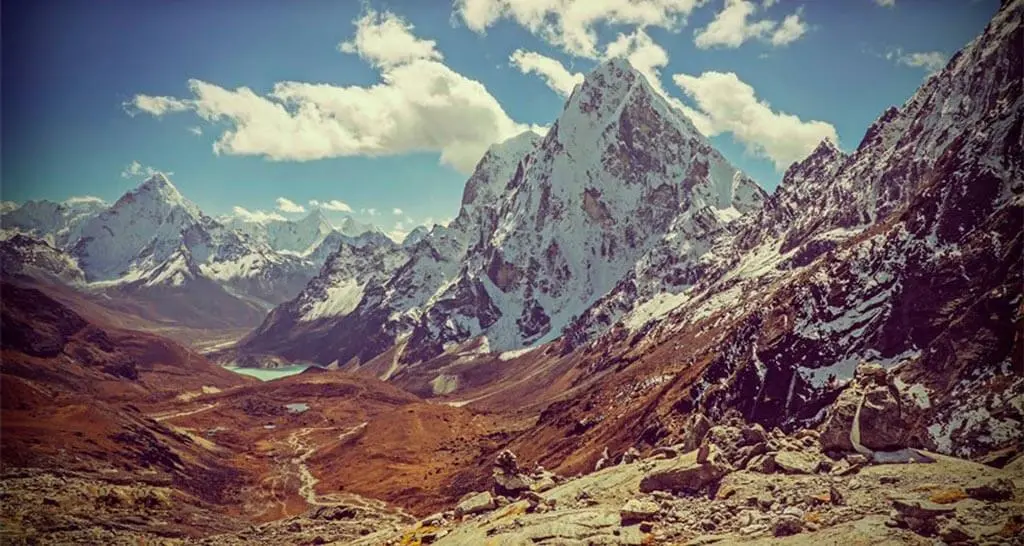
On the trail to Tengboche we have some amazing views of Mt. Everest, Mt. Nuptse, Mt Ama Dablam, and Thamserku. The trail zigzags through the hills until we reach Tengboche where we will stay overnight at a teahouse.
The early morning light at Tengboche provides us with a perfect photo opportunity of the surrounding scenery. On the trail, we pass numerous Chortens and Mani walls and several small villages and will stop for lunch at a village with a reputation for serving delicious food. In the afternoon we head north to Pheriche or alternatively can follow an eastward trail beneath the towering north face of Mt Ama Dablam. The trail is fairly easy-going as we enter the Imja Valley that slowly widens as we get nearer to the Lobuche River. We will then head down to the river and then have a steep climb heading up to Dingboche. Dingboche is unusual in that its fields are surrounded by stone walls, protected them from grazing animals and strong winds, with crops of barley, buckwheat, and potatoes. Tonight we stay at Dingboche.
Today is another very important day on the trek and is dedicated to helping us acclimatize before heading to higher altitudes. A short trek to the Nagarjuna Hills offers some marvelous views of Mt. Makalu and will also help us to acclimatize. Medical experts recommend being active rather than sit idle during this process of acclimatization.
First thing this morning we head to Dughla Village and then cross the steep moraine at the base of the Khumbu Glacier, having to cross slopes strewn with boulders. We continue our ascent to Chupki Lhara that has an array of stones with prayer flags placed as a memorial to climbers Scott Fischer (American) and ten-time Everest summiteer Babu Chiri Sherpa (Nepalese guide) who died while trying to climb Mt. Everest. On the trail to Khumbu Glacier moraine, we notice many huge peaks right before our eyes: Khumbutse, Lingtren, Pumori, and Mahalangur Himal. This scene will leave you awe-struck.
We are now heading to our final destination, slowly heading to higher elevations and will pass Gorak Shep Lake and then later come to a memorial in honor of the Indian mountaineers who have died on the mountain. Walking now is more physically challenging as a result of the thinner air at this higher altitude. The trail has rocks, moraine, and streams to cross before arriving at EBC. The first thing we see on arrival at EBC is the variety of colorful tents of mountaineers waiting for the right conditions before an attempt on the summit. From EBC we can see Nuptse, Khumbutse, and Pumori and the snow gleaming on their peaks. After a rest and look around EBC we head back to Gorak Shep for a well earned night’s sleep.
An early morning start and a 1.5-hour trek lead us to Kala Patthar taking advantage of the spectacular array of colors at sunrise on Everest and other towering peaks. After clicking madly we put our cameras down before heading back to Gorekshep for a well-deserved breakfast before continuing on to Dzolgla. In total the trek from Gorak Shep to Lobuche takes about 2 hours followed by another 2-hour trek that takes us back to Dzongla. Today we will have trekked for approximately 7 hours and after this mammoth effort will sleep soundly at Dzongla which is the only option before reaching Chola Pass. Breakfast, Lunch, and Dinner included.
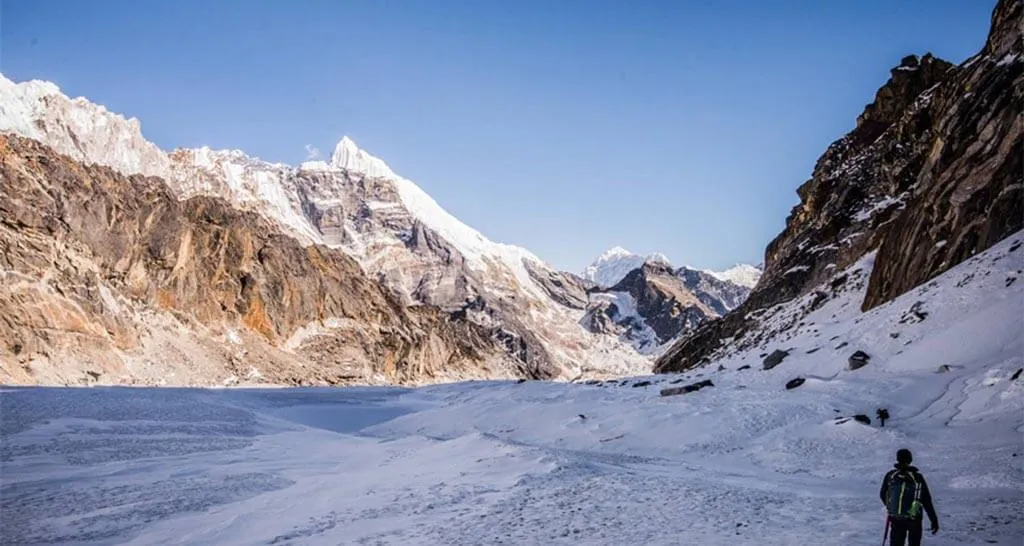
Early morning after breakfast, we start our walk from Dzongla to the Cho-la pass. The walk over the glacier is an enjoyable experience if we can make the trip during the best season otherwise excess snow makes it impossible to cross the pass. As the darkness returns we trek down to Tagnag to spend the night there. Breakfast, lunch and dinner included.
A relatively short trek of around 5-6 hours today takes us to Gokyo where we stop for lunch. The rest of the day is spent exploring the Gokyo Valley and if time permits visit the glaciers and turquoise lakes of the Gokyo Valley. During our trek, we are gifted with some magnificent views of several massive soaring Himalayan peaks, such as Everest, Cho-Oyu (8188m 6th highest in the world), Lhotse Makalu and others. Tonight we stay at Gokyo. Breakfast, lunch, and Dinner Included.
An early morning start sees us climb Gokyo Ri (5333m) to take in a jaw-dropping view of the enormous Ngozumpa glacier (36km long), and views of the upper Gokyo Valley and the incredible peaks of Everest, Lhotse, Makalu, Nuptse, Cho-Oyu, and Gychung Kang. We will then have breakfast and descend to Dole (4200m) where we will spend the night. Breakfast, Lunch, and Dinner Included.
Today is down-hill sailing as we pass through the Sherpa villages of Dole with the mountains towering behind us. We then head to the famous Buddhist town of Namche bazaar alive with its abundance of Sherpa culture and vibrant atmosphere where trekkers share their stories. Tonight we stay at Namche Bazaar. Breakfast, Lunch, and Dinner Included.
Today we head back to Phakding on our last day on the trail. We expect to arrive at Lukla early enough to allow you to explore the village and the immediate countryside. You will take a deep breath and look back on this amazing journey and maybe go over your photos and catch up on emails to your family and friends. This is the time to look back on this incredible journey and of accomplishing this physically challenging trek.
An early morning flight takes us back to Kathmandu – this time you will have a different perspective of the mountains below. You have had a personal taste of this vast region. At Kathmandu, you will have time to do some last-minute shopping for souvenirs or to catch up with friends. You can also wander through Thamel and maybe head for a café or bar for your last night out in Nepal. Our guides will be available to point you in the right direction, whether it is for sightseeing or shopping.
This is your last day in Nepal. A representative from Sherpa Teams will take you to the airport at least three hours prior to your departure and wish you a safe journey home. We anticipate that on your flight you will already be making plans for your next exciting adventure into the Himalayas of Nepal.
Everest Base Camp With Gokyo lake Trek INCLUDES & EXCLUDES
Cost Included In Your Package
- Airport transfer on arrival and departure by private vehicles
- Two nights’ standard accommodation in a 3-star hotel in Kathmandu in a twin-sharing basis including 2 breakfasts.
- Three meals a day (Breakfast, Lunch, and Dinner, the main course) during the trek.
- One highly experienced Sherpa Teams’s government-licensed, English-speaking local guide covering meals, flight, insurance, accommodations, and equipment for the guide.
- Strong, helpful Sherpa porters with proper safety equipment and walking equipment, his salary, food, accommodation, and insurance (one porter for two people).
- All the necessary documents such as Sagarmatha national park Fees and TIMS card (Trekking Information Management System)
- Trekking lodges or tea houses during the trek (Standard)
- Use of sleeping bag, down jacket, duffel bag and walking poles (if you don’t have your own, to be returned after trip completed).
- An assistant guide for the group of 8 pax or above
- Round trip flight from Kathmandu – Lukla - Kathmandu including applicable departure taxes
- Seasonal available fresh fruits every evening after dinner.
- Sherpa Teams' Certificate of appreciations after the successful trek
- Sherpa Teams’s complimentary free hiking T-shirt
- Oximeter to measure your oxygen and Pulse level during the trek in the mountain, it’s very useful for all the trekkers to be aware of the high altitude sickness.
- Emergency rescue operation assistance in arranging in case of complex health conditions (funded by your Travel Insurance)
- All government, Local taxes, and official Expenses
Cost Excludes
- Nepal entry visa fee (easy to obtain the visa on arrival at Tribhuvan International Airport – Kathmandu). $30 USD for 15-day, $50 USD for 30 Days, and $125 USD for 90 Days visa.
- Extra nights accommodation and meals before and after the trek
- International airfare
- All the alcoholic and nonalcoholic, soup, tea, coffee, hot chocolate, cocoa, mineral water, extra food, cold and hot drinks on trek ( i.e. those you choose to purchase along the way and during evenings in the tea houses)
- Travel insurance - insurance has to cover emergency high-altitude rescue and evacuation
- Personal cloths and trekking equipment
- Additional cost, the itinerary modifications or delay caused by out of management control due to the weather condition, illness, change of government policies, strikes, and physical condition, etc.
- Gratitudes to the guides and staffs (Recommended by Nepali culture )
- Any other expenses that are not mentioned in the Price "inclusive section" of this program
- NOTE: If you return earlier from the trek due to sickness or any problem, the money you paid for the flight, hotel, mountain room, food, etc. is nonrefundable, and you will need to bear the expenses for the hotel, food, etc. in Kathmandu yourself.
Everest Base Camp With Gokyo lake Trek PACKING LIST
The following information will give you some idea about what you need to bring for the trek. It is important you do not forget the essential items, as this will determine your comfort and safety on the trek. Equally important is that you do not burden yourself with unnecessary equipment on the trek.
- Sleeping Bag (Sherpa Teams will provide but need to return after completing the trip)
- Duffel Bag (Sherpa Teams will provide but need to return after completing the trip)
- Fleece jacket or pullover
- Waterproof windbreaker or windcheater
- Thermal underclothes
- Rain poncho
- Down jacket (Sherpa Teams will provide but need to return after completing the trip)
- Fleece or wool trousers
- Sun hat or scarf
- Trekking pants (two pairs)
- Mittens or woolen gloves
- Hiking socks (several pairs)
- Moisture-wicking shirts, including t-shirts
- Trekking shoes or boots with spare laces
- Flip-flops or sandals for relaxing in the evenings
- Underwear (several pairs)
- Swimsuit or swimming costume
- Sunglasses
- Headlamp or flashlight/torch
- Sleeping bag (Sherpa Teams can provide this for you)
- Trekking poles (if desired)
- Hiking backpack with a capacity of at least 40 liters
- Small lock for your backpack
- Reusable water bottles (at least two liters)
- Water purification tablets or filtration device
- Wash towel
- Basic first aid kit
Toiletries (tissues, toilet paper, moisturizer, lip balm, sunscreen, sanitary pads, hand sanitizer, nail clippers, a small mirror, toothbrush, toothpaste, glasses, contacts, etc.)
GOOD TO KNOW ABOUT Everest Base Camp With Gokyo lake Trek
Accommodation
You will be accommodated in 3-star hotels in Kathmandu. During the trek, we will be staying at lodges/ teahouses. You may find comfort and better quality teahouses - having attached bathroom - until Namche which is a thriving town seeing many more tourists and a greater range of accommodation. It should be noted that at higher elevations the quality of accommodation may not be as good, with more basic rooms with the bare necessities.
Meals during the trek
In Kathmandu, your hotel includes breakfast, whereas all meals (breakfast, lunch, and dinner) will be provided during the trek. A staple food of the Khumbu region is potatoes, oats, buckwheat, Sherpa stew and Tibetan bread. Sherpas’ started farming potatoes when the first seeds were introduced to the region in the early 90s. There is a limited choice of food at higher elevations and except many potato dishes. Potatoes are high in carbohydrates – an excellent source of energy needed at high altitudes.
Transportation
We use a private car for sightseeing and for the airport to hotel pick and drop off. We do not have to use public transportation or local buses during the trek. Our only flights are from Kathmandu to Lukla and return.
Physical fitness
EBC is a challenging trek where you often have to walk 6-7 hours a day. You don’t need past experience of hiking or trekking but if you have done any kind of trekking activities then it is always a plus!. We have met people from all walks of life, shapes and sizes who have completed the trek.The only difficult part is when altitude sickness strikes and the effect that it can have on your body. Before leaving for Nepal it is good if you can prepare yourself physically by increasing your stamina and oxygen intake.
Remember – The better prepared – the more enjoyable your trek!
ROUTE MAP OF Everest Base Camp With Gokyo lake Trek
Gallery of Everest Base Camp With Gokyo lake Trek

Everest Base Camp With Gokyo lake Trek Departures
Every departure listed below is 100% Guaranteed — once you book, your trip will run as scheduled regardless of group size.
Select a departure month
Fill out the form below and a Travel Expert will reach out to create your perfect tour.
FAQS Related to Everest Base Camp With Gokyo lake Trek
Others
The level is more difficult than other trekking programmers. However, Sherpa Expedition and Trekking tries its best to make the journey as easy, adventurous and joyful as possible.
Bottled water is easily available at a low cost. But you can not use plastic bottles in the Everest region. So, they do not sell plastic bottled mineral water. You need to drink mineral water or boiled filtered water in those areas. It is better to use water purification drops and tablets which you can either bring from your own country or buy in Kathmandu or Pokhara. Sherpa Expedition and Trekking also provides water purifier pill
Weather on the trail to Everest Base Camp With Gokyo Lake is always changing and impossible to predict. Here is a list of probable temperature and weather conditions in each month. Month Temperature Weather and Nature January Max 4°C in the daytime to min -17°C in the nights and mornings Blue skies, freezing weather February Max 4°C in the daytime to min -15°C in the nights and mornings Mild and humid, good visibility March Max 7°C in the daytime to min -12°C in the nights and mornings Days are short and the temperature starts to warm up, chances of occasional snow falls April Max 10°C in the daytime to min -5°C in a night Moderate temperature with amazing landscape, rhododendron and wildflowers May Max 15°C in the daytime to min 0°C in a night Days are still long, warm, and sunny June Max 16°C in the daytime to min -1°C in a night Rainy season July Max 15°C in the daytime to min 2°C in a night Hot and humid Auguest Max 16°C in the daytime to min 2°C in a night Max 16°C in the daytime to min 2°C in a night September Max 15°C in the daytime to min 2°C in a night End of monsoon, no clouds October Max 12°C in the daytime to min -6°C in a night Stable weather condition November Max 6°C in the daytime to min -12°C in a night Days are sunny and bright, cold during the night, sleeping bag is most. December Max 4°C in the daytime to min -14°C in a night Foggy and cloudy weather I have never hike before, can I make it to Everest Base Camp With Gokyo Lake? Yes, you can. No matter who you are, as long as you are reasonably fit, can walk for 5-6 hours a day and trek/hike a few uphills, Sherpa Expedition and Trekking Trekking team will support you to the fullest to transform your dream of standing Everest Base Camp With Gokyo Lake into reality.
The month of March to May in Spring and September to December in autumn seasons are considered the best for the Everest Base Camp Trek as the weather conditions become favorable during this time, providing you with good visibility and a suitable atmosphere for Everest Base Camp With Gokyo Lake trekking
No, there is no age limit for the trek to Everest Base Camp With Gokyo Lake but, you need to be in good physical shape and have a positive attitude. We also suggest you to prior to the excursion though we suggest you to please see your doctor and obtain necessary permission and advice, as well as medications for traveling in extreme altitude prior to the excursion.
During trekking, you will be served meals in the teahouses. Typical meals are noodles, rice, pasta or potato dishes along with vegetables and egg/chicken/meat dishes. Other items mostly served as breakfasts include Tibetan, egg, pancake, bread, porridge, muesli, and toasts with peanut butter and honey.
A teahouse trekking accommodation will be made for you for the Everest Base Camp With Gokyo Lake trekking whereby you will be able to stay at tea house(Local lodge) and have wholesome food and net and clean comfortable bed throughout your trekking journey. This form of arrangement also allows you to carry less baggage; you can trek at your own pace and enjoy the Everest panorama on your own schedule. It is also an eco-friendly way of trekking whereby trekkers can have more contact with the local's sherpa peoples.
Most of the teahouses on the Everest Base Camp With Gokyo Lake trail have squat toilet facilities but recently built lodges have western-style toilets as well. Nowadays, flush toilets are also being introduced with number of increasing foreign mountaineers each year. It is highly recommended to carry your own toilet paper and other required toiletries. Hot shower facilities are available till Gorakshep. The most common type is a bucket shower, usual buckets with tap filled with hot water and placed in a shower room. Hot shower costs from US$ 4 to 15 per use and the price increases along with the elevation. Attached bathrooms and toilets are not available unless you book for a luxury lodge during the Everest Base Camp With Gokyo Lake trek.
What you want to wear depends on you but we suggest you wear warm clothes during the Everest Base Camp With Gokyo Lake trekking. A down jacket, thermal longs and top, comfortable trekking trousers, t-shirts, fleece, windproof jacket, hat, scarf, and gloves might be useful. There are numerous trekking shops in the Thamel area of Kathmandu where you can get all of these items in both local and branded stores alike. Sherpa Expedition and Trekking may also accompany and assist you if required.
During the Everest Base Camp With Gokyo Lake trekking, you will be on a long journey for which you will need two bags to keep your belongings. A rucksack/duffle bag and a day bag for personal items. Sherpa Expedition and Trekking will provide you with a duffle bag (which is need to refund after the trek) that you can use throughout your entire journey and even afterward. These bags are durable and hence perfect for any kind of trekking journey. While the duffle bag will be carried by the potters, you will have to carry a day bag on your own. A day bag is a small backpack that has enough room for everything you will need on a day hike such as lunch, water, extra clothing and perhaps a few personnel items like camera, battery chargers, etc
If possible, we suggest you bring your own equipment. However, sleeping bags and down jackets will be provided to you by Sherpa Expedition and Trekking. With regards to trekking poles, if you are used to walking with it then take them with you, as you will probably find them useful especially on the way down. They are not essential though and the walk is manageable without them. It is mostly a personal preference. If you prefer to take the trekking poles with you on the trekking then you can either bring your own pole or buy it from numerous options available in Kathmandu itself.
Yes, if you have a bag of extra clothing for when you return from the trekking, you will be able to store it safely in Kathmandu Sherpa Expedition and Trekking office. The storage facility is provided by most hotels and lodges in Kathmandu or you can also store it in our office for the duration of the trekking.
Our itinerary has been specially tailored to prevent any kind of AMS (Acute Mountain Sickness) while moving up to higher altitudes. Normally, altitude sickness starts from 3,600 meters and above. You will be trekking at a relatively slow and gradual pace as part of the acclimatization process. Cut off caffeinated, alcoholic and smoking items. Drink at least 4 liters of water a day. Trek slow. Don't skip the acclimatization days. Better to continue with Diamox (if any symptoms show up). Drink Garlic Soup. In the higher elevation, there is less oxygen in the air and this is more so while crossing high passes. Our expert guides will advise you on how to avoid AMS and treat it when/ if required
Make sure to have both medical and evacuation insurance before coming to Nepal for Everest Base Camp With Gokyo Lake trekking. You should be careful in choosing a policy while traveling to a Himalayan country like Nepal as some insurance companies may make special exceptions for adventure travel. If you are confused about the insurance, please inform us and we will help you. It is usually better to arrange your insurance in your country before travel.
The trekking will be 5-7 hours a day depending upon the landscape and destination. when you cross the high pass that day need to walk 7 to 10 hours.
It takes 6 to 19 days to reach Everest Base Camp With Gokyo Lake top depending upon the mode of transportation and packages of Sherpa Expedition and Trekking offers.
We at Sherpa Expedition and Trekking Team always have the safety, comfort, and satisfaction of our valued customers as our foremost priority at all times, and we assure you a wonderful and unforgettable time with us in our beautiful country. Sherpa team members of Sherpa Expedition and Trekking will be carrying all the necessary gear, equipment, and first aid kits and they have extensive first aid training. If a trekker falls sick on high altitude, the leader will decide whether to continue the trek. In case of emergency, Sherpa Expedition and Trekking have a rescue helicopter to bring you back from the higher elevation. Moreover, Sherpa Expedition and Trekking also provides oximeter to monitor the oxygen level at high altitude and offers regular health check-up facilities
You can either trek on foot or by a helicopter. Sherpa Expedition and Trekking offer exciting and reasonable Helicopter trek to Everest Three passes for 8 days and 19 days. Sherpa Expedition and Trekking can also customize your tour as per your necessity.
The flights are usually regular between September and May. But due to high altitude, bad weather and unforeseen technical issues, you may experience a delay or cancellation of the flight. On the occurrence of such events, Sherpa Expedition and Trekking charter a helicopter to make sure you are on the safe schedule either for a trek or for your flight back home which would cost extra charge as an unexpected event. However, if the visibility is less than 1,500 meters, it is unable to operate helicopter facilities and Sherpa Expedition and Trekking will reschedule the flight.
Sherpa Expedition and Trekking will provide one porter for two trekkers to carry 20 kgs of luggage (maximum 10 kg for each trekker). Please be sure your porters are not overloaded because they do not carry only your equipment but also lift your spirit to reach new heights, and your love, affection, and generosity can be the reason for them to work hard to take you to your destination. However, the weight limit on flights to the Everest region, basically to Lukla is a total of 10 kgs and you need to pay an extra amount per kg for the excess baggage. Sherpa Expedition and Trekking pays up to 5 kgs of extra baggage making your total to 15 kgs with your hand bag.
Garlic soup is a must while trekking. Sherpa Expedition and Trekking recommend trekkers to drink green tea, lemon tea, hot lemon ginger tea and drink at least 2-4 liters of water a day. However, it is better to avoid alcohol and alcoholic beverages, caffeinated items, and hot-chocolates at high altitude
Sherpa Expedition and Trekking Trekking won’t recommend non-veg items because the meat in such places may not hygienic and healthy. Sherpa Expedition and Trekking also encourage to avoid dairy and cheesy items and strongly suggest not to consume them during the trek. So, our packages are suitable for both vegan and vegetarians.
Your guide and porters are a big reason why you got a chance to feel something very few can have. Apart from guiding and carrying your necessities and being mindful of your safety, they want to see you happily succeeded more than anyone like family and help you successfully complete the trek safely. So, your tips reflect gratitude towards them. So, tipping is a recommended culture for porters and guide in Nepal as a gesture of thankfulness.
Sherpa Expedition and Trekking will introduce dozens of shops selling knock-off gear in Kathmandu. You can also barter those gears at the knock-off places but be sure you keep the receipt safely. Moreover, you can rent the needed gears if you do not want to buy them.
Yes, most guesthouses offer Wi-Fi, for a small charge. it cost USD$5 per day.
ATM services are available only in Namche Bazaar and Lukla. However, the services might not work or run out of cash. Therefore, we suggest you carry a small amount of money to buy snacks, etc during the trekking.
Most of the tea houses/ lodges have electricity whereby you will be able to charge your iPod or camera batteries. Please note that lodges/tea houses will charge you some extra money for the services. The fee may vary from 1 USD to 3 USD per hour.
RELATED PACKAGES


Latest Traveller’s Reviews
Travel experiences of our clients who recently returned from their trips.
100%
Based On 14 Reviews
Samuel Padilla
United States
August 5, 2024
Seamless Adventure
Kazimierz Przygodzki
United States
July 16, 2024
Exceptional Experience
Jessica Brand
Netherlands
May 11, 2024
Unforgettable Journey

Write Your Review
Average Customer Ratings
How The Travellers Have Rated This Package
14
0
0
0
0