ANNAPURNA CIRCUIT TREK 14 DAYS FROM POKHARA
Trip Overview
The 14-day Annapurna Circuit Trek is an exceptional journey designed to offer an immersive experience through the heart of the Annapurna region. This trek combines breathtaking mountain views, rich cultural experiences, and physical challenges, making it one of the most iconic trekking circuits in the world.
Beginning with a scenic drive from Pokhara, the trek introduces you to beautiful forests, terraced fields, and remote villages as you gradually ascend into higher altitudes. The route takes you through picturesque villages, where you’ll interact with locals and get a glimpse of traditional life in the Himalayas. The trek rewards you with awe-inspiring views of the Annapurna and Pisang Peaks, and as you journey further, you’ll experience the Tibetan-influenced culture in villages like Ngawal, known for its monasteries and magnificent mountain vistas.
An acclimatization day in Manang helps trekkers adjust to the altitude, providing an opportunity to explore nearby sights like Ice Lake and Lama Cave. This day is crucial for ensuring a safe and successful trek to higher elevations. Afterward, the trek leads you to Thorong Phedi, the base camp for crossing the challenging Thorong La Pass. Reaching the pass at 5,416 meters is a significant achievement, offering unparalleled views of the surrounding peaks before descending to the spiritual town of Muktinath, an important pilgrimage site for both Hindus and Buddhists.
The trek continues with a rejuvenating visit to the natural hot springs in Tatopani, followed by a journey through lush forests and charming villages to Ghorepani. A highlight of the trek is the early morning hike to Poon Hill, offering one of the best sunrise views in the Himalayas. The trek concludes with a descent to Nayapul, followed by a drive back to Pokhara, marking the end of this unforgettable adventure.
The Annapurna Circuit Trek is more than just a physical challenge; it’s an exploration of the beauty of the Himalayas, the rich culture of the mountain communities, and the resilience of the people who call this region home. It’s a once-in-a-lifetime experience that leaves trekkers with memories to cherish forever.
ANNAPURNA CIRCUIT TREK 14 DAYS FROM POKHARA Day-by-day ITINERARY
Day 1 : Drive from Pokhara to Jagat (1,300m) - Duration: 8-9 hours.
Your journey begins with a scenic drive from Pokhara to Jagat, passing through picturesque villages and lush greenery. The drive provides the first glimpses of the Himalayas and sets the tone for the adventure ahead.
Day 2 : Trek from Jagat to Dharapani (1,960m) - Duration: 5-6 hours.
On this day, you’ll embark on your first trek towards Dharapani, crossing suspension bridges and walking through terraced fields. The route gradually ascends, offering views of the surrounding mountains and forests, until you reach the charming village of Dharapani.
Day 3 : Trek from Dharapani to Chame (2,760m) - Duration: 5-6 hours.
Continuing your ascent, you trek through pine forests, passing by traditional villages, and witnessing stunning views of the surrounding peaks. Chame is a beautiful village nestled in the heart of the mountains, offering panoramic views of the peaks.
Day 4 : Trek from Chame to Upper Pisang (3,300m) - Duration: 5-6 hours.
The trek today takes you through rhododendron forests and lush landscapes, eventually reaching Upper Pisang. Here, you’ll be rewarded with breathtaking views of Annapurna II and Pisang Peak, making it one of the most memorable sections of the trek.
Day 5 : Trek from Pisang to Manang (3,500m) via Ngawal Village - Duration: 8-9 hours.
From Pisang, you’ll pass through Ngawal Village, a traditional settlement known for its Tibetan influence. The trail continues uphill with stunning views of Annapurna II and III, eventually reaching Manang, where you’ll be surrounded by alpine beauty.
Day 6 : Rest Day at Manang for Acclimatization.
A full rest day in Manang is essential for acclimatization. This allows your body to adjust to the increasing altitude. You can use this day to explore the area, visit the local monastery, or take a hike to Ice Lake or Lama Cave to experience the natural beauty of the region.
Day 7 : Trek from Manang to Yak Kharka (4,200m) - Duration: 4-5 hours.
After acclimatization, you’ll begin your trek to Yak Kharka, passing through open pastures and experiencing views of the surrounding peaks. The trail gradually ascends as you reach your next destination, where the landscape becomes increasingly rugged.
Day 8 : Trek from Yak Kharka to Thorong Phedi (4,600m) - Duration: 3-4 hours.
Today's trek takes you to Thorong Phedi, the base camp for the Thorong La Pass. The trail is challenging but rewarding as you pass through alpine terrain and experience panoramic views of the surrounding mountains.
Day 9 : Trek to Muktinath via Thorong La Pass (5,416m) - Duration: 7-8 hours.
This is the most challenging and rewarding day of the trek, as you’ll ascend to the highest point of the circuit, Thorong La Pass (5,416m). After reaching the pass, you’ll descend to Muktinath, a sacred site for both Hindus and Buddhists, known for its religious significance and stunning surroundings.
Day 10 : Drive from Muktinath to Tatopani (1,200m) - Duration: 6-7 hours.
After visiting Muktinath, you’ll take a drive to Tatopani, a village famous for its natural hot springs. The drive offers scenic views as you descend into lower altitudes, and you’ll have the chance to relax and rejuvenate in the hot springs.
Day 11 : Trek from Tatopani to Ghorepani (2,860m) - Duration: 7-8 hours.
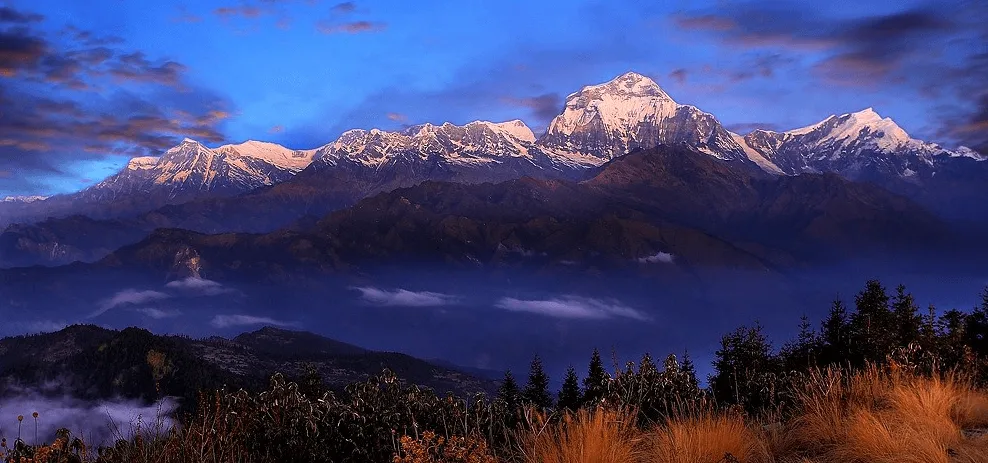
From Tatopani, you’ll trek to Ghorepani, passing through lush forests and traditional villages. This section of the trek offers fantastic views of the Dhaulagiri and Annapurna mountain ranges, and the village of Ghorepani provides a charming resting place.
Day 12 : Hike to Poon Hill (3,210m) & Trek to Tadapani (2,300m) - Duration: 5-6 hours.
On this day, you’ll hike early to Poon Hill to witness one of the most stunning sunrise views over the Himalayas. After enjoying the panoramic views, you’ll trek to Tadapani, another beautiful village offering great views of the Annapurna range.
Day 13 : Trek from Tadapani to Ghandruk (1,650m) - Duration: 3-4 hours.
Today’s trek takes you down to Ghandruk, a picturesque Gurung village known for its traditional architecture and cultural heritage. The trek is relatively short but offers excellent views of the surrounding mountains.
Day 14 : Trek from Ghandruk to Nayapul & Drive to Pokhara - Duration: 5-6 hours.
On the final day, you’ll trek from Ghandruk to Nayapul, where you’ll catch a drive back to Pokhara, marking the conclusion of your incredible 14-day Annapurna Circuit Trek. The journey down is scenic, offering one last view of the surrounding mountains before reaching the bustling town of Pokhara.
ANNAPURNA CIRCUIT TREK 14 DAYS FROM POKHARA INCLUDES & EXCLUDES
Cost Included in Your Package
- Drive from Pokhara to Besisahar by local bus and Besisahar to jagat by local shared Jeep.
- Drive from Muktinath to Tatopani by local bus & Nayapul to Pokhara by private car at the end of the trek.
- Tea House/Lodge accommodation during the trek.
- Three meals a day (Breakfast, Lunch, and Dinner) are provided throughout the trek.
- Experienced and qualified trek leader (guide) with a government license, and an assistant trekking guide for groups of 8 or more trekkers.
- Porter service: One porter for every two trekkers to help carry your luggage.
- Porters' coverage: Their salary, food, accommodation, insurance, and safety equipment.
- The Annapurna Conservation Area Permit (ACAP) fee is included.
- The Trekkers Information Management System (TIMS) card fee is covered.
- Use of trekking gear: Sleeping bag, down jacket, duffel bag, and walking poles (if you don't have your own), to be returned after the trek.
- Assistance with emergency rescue operations (funded by your travel insurance) in case of severe health conditions.
- Sherpa Expedition and Trekking appreciation certificate after completing the trek.
- Oxygen meter to check your pulse, oxygen saturation, and heart rate twice daily, ensuring your health and safety during the trek.
Cost Not Included in Your Package
- International Flight to and from Nepal.
- Nepal entry visa fee: Visas can be obtained easily on arrival at Tribhuvan International Airport, Kathmandu. The fees are as follows:
- $30 USD for a 15-day visa
- $50 USD for a 30-day visa
- $125 USD for a 90-day visa
- Accommodation and meals in Pokhara (other than those provided during the trek).
- Extra night accommodation in Kathmandu or Pokhara due to early arrival, late departure, or early return from trekking for any reason outside the scheduled itinerary.
- Personal expenses such as shopping, snacks, bar bills, tea, coffee, hot water, bottled or boiled water, shower fees, Wi-Fi, laundry, telephone calls, battery recharges, extra porters, etc.
- Personal clothing and gear not provided in the package.
- Travel insurance: It is strongly recommended to have insurance that covers trekking in high-altitude areas.
- Tips for your guide and porters, which is customary in Nepali culture.
- Additional costs or delays caused by circumstances beyond our control, such as landscape changes, bad weather, itinerary modifications for safety, illness, changes in government policy, political instability, strikes, or other unforeseen events.
- NOTE: If you return earlier from the trek due to sickness or any other reason, expenses for flights, hotels, meals, and other services are nonrefundable. You will be responsible for any additional costs incurred in Kathmandu or Pokhara.
ANNAPURNA CIRCUIT TREK 14 DAYS FROM POKHARA PACKING LIST
The following information will give you some idea about what you need to bring for the trek. It is important you do not forget the essential items, as this will determine your comfort and safety on the trek. Equally important is that you do not burden yourself with unnecessary equipment on the trek.
- Sleeping Bag (Sherpa Teams will provide but need to return after completing the trip)
- Duffel Bag (Sherpa Teams will provide but need to return after completing the trip)
- Fleece jacket or pullover
- Waterproof windbreaker or windcheater
- Thermal underclothes
- Rain poncho
- Down jacket (Sherpa Teams will provide but need to return after completing the trip)
- Fleece or wool trousers
- Sun hat or scarf
- Trekking pants (two pairs)
- Mittens or woolen gloves
- Hiking socks (several pairs)
- Moisture-wicking shirts, including t-shirts
- Trekking shoes or boots with spare laces
- Flip-flops or sandals for relaxing in the evenings
- Underwear (several pairs)
- Swimsuit or swimming costume
- Sunglasses
- Headlamp or flashlight/torch
- Sleeping bag (Sherpa Teams can provide this for you)
- Trekking poles (if desired)
- Hiking backpack with a capacity of at least 40 liters
- Small lock for your backpack
- Reusable water bottles (at least two liters)
- Water purification tablets or filtration device
- Wash towel
- Basic first aid kit
Toiletries (tissues, toilet paper, moisturizer, lip balm, sunscreen, sanitary pads, hand sanitizer, nail clippers, a small mirror, toothbrush, toothpaste, glasses, contacts, etc.)
GOOD TO KNOW ABOUT ANNAPURNA CIRCUIT TREK 14 DAYS FROM POKHARA
🚶♂️ Trekking Difficulty Level
Trekking the Annapurna Circuit can be challenging due to the high altitudes and varying terrain. While it’s a moderate trek suitable for trekkers with a good level of fitness, you will need to be prepared for long days of walking through forests, villages, and steep climbs. Be sure to prepare physically and mentally for this rewarding adventure.
🌄 Best Time to Trek
The best time to trek the Annapurna Circuit is from September to November and March to May. During these months, the weather is relatively stable, and you'll experience clear skies and moderate temperatures. Winter (December to February) can be harsh with heavy snowfall at high altitudes, and the summer monsoon (June to August) brings rain, making trekking difficult.
🏞️ What to Pack
Packing for the Annapurna Circuit Trek is crucial for a comfortable journey. Essential items include a good pair of trekking boots, warm clothing (especially for the higher altitudes), a sleeping bag, a rain jacket, trekking poles, and sunscreen. Layering your clothing is key as temperatures can fluctuate, especially as you gain altitude.
🧑⚕️ Health and Safety Tips
Stay hydrated and take proper rest to avoid altitude sickness, which is common above 3,000 meters. A rest day in Manang will help your body acclimatize to the altitude. Also, it's wise to consult your doctor before the trek, especially if you have any pre-existing conditions, and carry a basic first aid kit with you.
🏕️ Accommodation on the Trek
During the Annapurna Circuit, accommodations are generally in teahouses, which offer basic yet comfortable lodging and meals. Most teahouses offer twin rooms with shared bathrooms, and some might even have hot showers available for a small fee. Be prepared for simple living conditions, but the warmth and hospitality of the locals will make up for it.
🗺️ Permits Required
To trek in the Annapurna region, you will need the Annapurna Conservation Area Permit (ACAP) and the Trekkers' Information Management System (TIMS) card. These permits can be obtained in Pokhara or Kathmandu before your trek. Make sure to carry these permits at all times during your trek.
🧳 Luggage and Porters
You are allowed to carry only a certain amount of luggage while trekking. If you're traveling light, you can hire a porter to carry your gear. The weight limit for porters is generally around 15kg per person, and it's a great way to support the local economy while easing your load.
🏞️ Scenic Views and Highlights
The Annapurna Circuit Trek is renowned for its breathtaking views of towering peaks like Annapurna I, Dhaulagiri, Machapuchare, and Pisang Peak. Along the way, you'll also pass through culturally rich villages, ancient monasteries, and beautiful valleys. A sunrise at Poon Hill is one of the most iconic moments of the trek.
🛀 Hot Springs at Tatopani
After completing the strenuous part of the trek, you can relax in the natural hot springs at Tatopani, which are known for their healing properties. A soak here will help rejuvenate your tired muscles and provide a well-deserved break before heading toward the next leg of the journey.
📱 Connectivity and Communication
While on the Annapurna Circuit, there will be limited mobile network connectivity in remote areas. However, in towns like Manang and Pokhara, you can find internet cafes and mobile networks. It's a good idea to inform family and friends of your trekking schedule beforehand in case of emergencies.
ROUTE MAP OF ANNAPURNA CIRCUIT TREK 14 DAYS FROM POKHARA
Gallery of ANNAPURNA CIRCUIT TREK 14 DAYS FROM POKHARA

ANNAPURNA CIRCUIT TREK 14 DAYS FROM POKHARA Departures
Every departure listed below is 100% Guaranteed — once you book, your trip will run as scheduled regardless of group size.
Select a departure month
Fill out the form below and a Travel Expert will reach out to create your perfect tour.
FAQS Related to ANNAPURNA CIRCUIT TREK 14 DAYS FROM POKHARA
Others
What is the Annapurna Circuit Trek?
The Annapurna Circuit Trek is a famous trekking route in Nepal that takes you through the Annapurna region, offering stunning mountain views, diverse landscapes, and cultural experiences. The trek covers a variety of terrains and altitudes, reaching up to 5,416 meters at the Thorong La Pass.
How difficult is the Annapurna Circuit Trek?
The Annapurna Circuit Trek is considered moderate to challenging. While it doesn’t require technical climbing skills, the high altitudes and long daily treks make it physically demanding. It’s suitable for trekkers with a reasonable level of fitness and experience in hiking.
When is the best time to trek the Annapurna Circuit?
The best time to trek the Annapurna Circuit is from September to November and March to May. These months offer clear skies, moderate temperatures, and the best trekking conditions. The winter months (December to February) can be too cold, and the monsoon season (June to August) brings heavy rainfall.
What permits are required for the Annapurna Circuit Trek?
To trek the Annapurna Circuit, you need the Annapurna Conservation Area Permit (ACAP) and the Trekkers' Information Management System (TIMS) card. These permits can be obtained in Kathmandu or Pokhara before starting the trek.
How long does the Annapurna Circuit Trek take?
The Annapurna Circuit Trek usually takes around 12 to 14 days, depending on the pace and the itinerary. This allows for proper acclimatization and rest days, particularly in places like Manang, before attempting the Thorong La Pass.
Do I need a guide or porter for the Annapurna Circuit Trek?
Although it’s possible to trek the Annapurna Circuit independently, hiring a guide and/or porter is recommended. A guide can help with navigation, provide cultural insights, and ensure your safety, while a porter can help carry your luggage, making the trek more comfortable.
What is the accommodation like on the Annapurna Circuit Trek?
Most accommodations along the trek are teahouses, which offer basic facilities, including twin-share rooms and shared bathrooms. While the rooms are simple, you can expect warm hospitality, home-cooked meals, and a cozy environment for resting after long trekking days.
How do I prepare for the Annapurna Circuit Trek?
To prepare for the Annapurna Circuit Trek, focus on building your stamina and strength through cardio exercises, hiking, and walking with a backpack. It’s also important to be comfortable at higher altitudes and train at altitude if possible. Also, ensure you have the proper trekking gear, including a good pair of boots, warm clothing, and a first aid kit.
What is the weather like during the Annapurna Circuit Trek?
The weather varies depending on the altitude. In lower regions like Besisahar, the climate is temperate, but it gets colder as you ascend. At higher elevations, especially near Thorong La Pass, temperatures can drop below freezing, and snow is possible, even in the warmer months.
Can I do the Annapurna Circuit Trek if I have no previous trekking experience?
While the Annapurna Circuit Trek can be challenging, it is accessible to trekkers with a moderate level of fitness. If you have no previous trekking experience, it’s advisable to start training in advance, focus on endurance and stamina, and consider hiring a guide to help you along the way.




Latest Traveller’s Reviews
Travel experiences of our clients who recently returned from their trips.
100%
Based On 4540 Reviews
Richard Odell
United Kingdom
June 12, 2026
Annapurna Circuit with Tilicho Lake
Katie D
N/A
December 20, 2025
Trip of a Lifetime
Benjamin Carter
Belgium
May 29, 2025
Fantastic Trek Led by Skilled Guide

Write Your Review
Average Customer Ratings
How The Travellers Have Rated This Package
4530
10
0
0
0
People Considering This Package Right Now Check availability