Annapurna Circuit Trek 13 Days
USD 1,150 / Per Person
Trip Overview
This amazing and very popular 13-day trek on the Annapurna Circuit starts in Kathmandu and takes you through the Annapurna Conservation Area, visiting unique culturally rich Tibetan Buddhist Gurung and Magar villages, along trails bounded by magnolia and rhododendron forests. You will follow the route of early traders along the old salt route, be surrounded by soaring snow-capped peaks, witness unique flora and fauna before finally returning to Kathmandu. All accommodation, meals, and transport are included in the price!
The round Annapurna trek is one of the great trekking trails in the world, Trekking a complete circuit of the huge Annapurna Massif in central Nepal; This 13-day trek provides dramatic mountain scenery and fascinating life of local people, Buddhist and Hindus culture. T
The trek Start from Dharapani we head north up the Marshyangdi Valley, through lush green foothills and terraced rice fields. climbing higher elevation we progress through alpine forests to a dry desert region and the Tibetan Buddhist village of Manang Valley. The Himalayas views are fantastic, Lamjung, Himalchuli, Mt. Manaslu, and the Annapurnas tower magnificently over the Manang valley. The features of this trek are crossing the famous Thorong La pass (5,416m) to enter the Kali Gandaki Valley and the long descent to the Hindu temple at Muktinath. We drive to Pokhara (known as the natural and beautiful Lake City) with the greatest Himalayan drive over the deepest gorge in the world (Kaligandaki Gorge).
Sherpa Expedition and Trekking Team will ensure your safety and comfort at all times to make this an enjoyable adventure into the wilds of the Annapurna region.
Annapurna Circuit Trek 13 Days Day-by-day ITINERARY
We have a fairly long drive to where our trek begins. This is a good time to sit back and take in the sights of the changing countryside; rivers, terraced farmlands and views of the stunning Himalayan Mountains. Tonight we will stay at a guesthouse.
Today we start out by crossing the river and then head up to a ridge where we follow the trail to Tal, the first village in the Manang region. Just before Tal we pass a waterfall. We will stay overnight at Tal.
Today we trek along a broad flat valley and then climb a stone stairway to 1860 meters. The trail is then undulating until we reach Dharapani at 1890 meters. We then arrive at the Tibetan village of Danakyu with its characteristic flat stone roofed houses.
This morning we follow a rough and rocky trail and climb to Timang at 2750 meters and through a forest close to the river before coming to the village of Kopar at 2590 meters. Next we come to Chame, the headquarters of the Manang district from where we can see Annapurna II and two hot springs close to the village.
We walk through a steep and narrow valley from where we have our first views of Paungda Danda, a massive curved rock face soaring 1500 meters vertically up from the river bed. From here we can look up to the gigantic Annapurna II and Pisang Peak. We then head down to Manang Valley. Tonight we will stay at a guest house in Pisang.
Today we enter the upper Manang region that begins at Pisang. Today we head to Braga; a Tibetan village with its characteristic architecture and houses built one upon the other. One of the main features here is its Gompa (Tibetan Buddhist temple), the largest in the entire Manang region. Manang is also a popular place for trekkers and is a good place to acclimatize before heading to higher altitudes. We will stay here overnight.
Health care professionals recommend that before heading to higher altitudes trekkers acclimatize. They also strongly recommend that you stay active during this period. Today we will climb up to Mt. Khangsar (3756m) as a means of acclimatizing. We will stay the night at Manang.
Today we have a 10.4 km ascent to Yak Kharka on a trail that passes through juniper forests. On the trail it is possible we will come across yak grazing in these high alpine pastures. We will also pass the only teahouse at Thorong Khola. Depending on the weather conditions and how energetic we feel we may decide to trek a little further and stay overnight at Letdar.
The trail initially descends and crosses the river at 4310 meters and then we have to climb up to Phedi at 4450 meters. At High Camp (4700m) there are several good guest houses where we can stay.
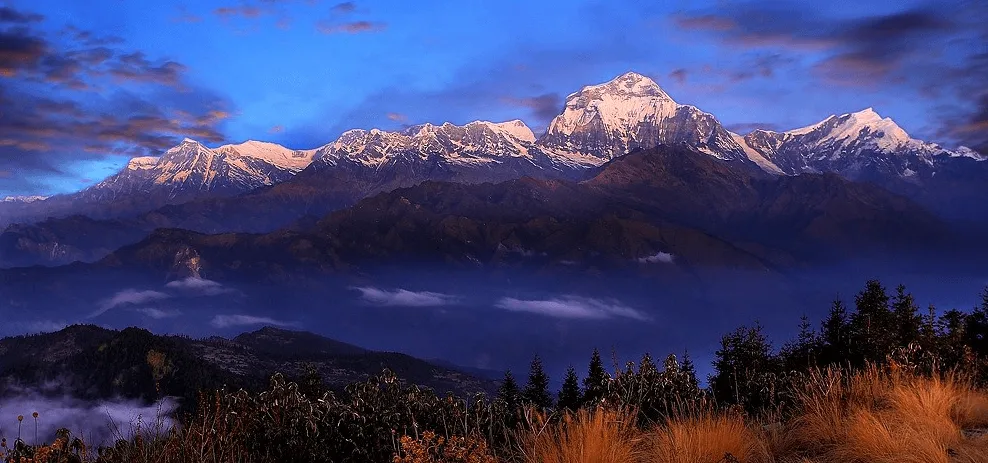
Today is one of the toughest days on the trek as we hike for up to 8 hours. The higher altitude also makes it more hard going with less oxygen and the possibility of very strong winds in these alpine regions. On the trail we may pass sheep, yaks and merchants transporting their goods on mules or on their backs. At Thorong La Pass we will have incredible views of Annapurna, Gangapurna and the distinct peak of Khatungkang (6484m). We then descend for around 1600 metres and along the trail can expect to have views of Dhaulagiri (Dhavali giri, meaning “White Mountain”), the highest mountain that is wholly within the borders of Nepal. The trail is less challenging as we head to Muktinath where we stay overnight.
This morning we head downhill to the Kaligandaki River and then follow a road taking a jeep or bus to a bus to Tatopani where we will stay the night.
This morning we head to Pokhara in a Local Bus with a break for lunch along the way.
On the last day of our journey, we head back to Kathmandu through the mountain passes and across rivers until we arrive at Kathmandu. Tonight Sherpa Expedition Teams will host a farewell dinner at a local Nepali restaurant. This is a chance to say your farewells to your guide and fellow trekkers.
Annapurna Circuit Trek 13 Days INCLUDES & EXCLUDES
Cost Included In Your Package
- Three meals a day (Breakfast, Lunch, and Dinner) during the trek.
- One-night hotel accommodation in Pokhara with breakfat
- Tea house(Trekking Lodge) accommodations during the trek.
- Fresh fruit every evening after dinner.
- ACAP entry permit & TIMS card.
- Bus to Bhulbule and again the tourist bus from Pokhara to Kathmandu.
- Shared Jeep /Bus from Muktinath to Pokhara
- English-speaking guide with all his salary, food, drinks, accommodation, Transport and insurance
- A Strong, helpful porter with proper equipment (one porter for two people).
- Medical supplies (first aid kit will be available).
- Arrangement of Emergency Helicopter service which will be paid by your Travel insurance company.
- Sleeping bags, Down Jacket, duffel bag, and Walking Poles (if you don’t have your own, to be returned after trip completed).
- Sherpa Expedition and Trekking T-shirt
- Trip achievement certificate after successful trip completion.
- Oxygen meter to check your pulse and oxygen saturation and heart rate twice daily (Very useful to check Altitude Mountain Sickness(AMS) symptoms) which will ensure your health during the trek.
- Assistant guide group size above 8+ persons.
Cost Excludes
- Meals whilst you are in Kathmandu Lunch and Dinner.
- Meals in Pokhara.
- Nepal entry visa fee (easy to obtain the visa on arrival at Tribhuvan International Airport – Kathmandu). $30 USD for 15-day, $50 USD for 30 Days, and $125 USD for 90 Days visa.
- Your Travel and medical rescue insurance(recommended).
- International airfare.
- All the alcoholic and nonalcoholic, soup, tea, coffee, hot chocolate, cocoa, mineral water, extra food, cold and hot drinks on trek ( i.e. those you choose to purchase along the way and during evenings in the tea houses)
- All desserts & sweet things like chocolate, cake, pie, pudding.
- Hot shower and battery charging at the tea houses.
- Tips for the guide, porter, and driver (tipping is expected)
Annapurna Circuit Trek 13 Days PACKING LIST
The following information will give you some idea about what you need to bring for the trek. It is important you do not forget the essential items, as this will determine your comfort and safety on the trek. Equally important is that you do not burden yourself with unnecessary equipment on the trek.
- Sleeping Bag (Sherpa Teams will provide but need to return after completing the trip)
- Duffel Bag (Sherpa Teams will provide but need to return after completing the trip)
- Fleece jacket or pullover
- Waterproof windbreaker or windcheater
- Thermal underclothes
- Rain poncho
- Down jacket (Sherpa Teams will provide but need to return after completing the trip)
- Fleece or wool trousers
- Sun hat or scarf
- Trekking pants (two pairs)
- Mittens or woolen gloves
- Hiking socks (several pairs)
- Moisture-wicking shirts, including t-shirts
- Trekking shoes or boots with spare laces
- Flip-flops or sandals for relaxing in the evenings
- Underwear (several pairs)
- Swimsuit or swimming costume
- Sunglasses
- Headlamp or flashlight/torch
- Sleeping bag (Sherpa Teams can provide this for you)
- Trekking poles (if desired)
- Hiking backpack with a capacity of at least 40 liters
- Small lock for your backpack
- Reusable water bottles (at least two liters)
- Water purification tablets or filtration device
- Wash towel
- Basic first aid kit
Toiletries (tissues, toilet paper, moisturizer, lip balm, sunscreen, sanitary pads, hand sanitizer, nail clippers, a small mirror, toothbrush, toothpaste, glasses, contacts, etc.)
GOOD TO KNOW ABOUT Annapurna Circuit Trek 13 Days
Accommodation
You will be accommodated in 3-star hotels in Kathmandu. During the trek, we will be staying at lodges/ teahouses. You may find comfort and better quality teahouses - having attached bathroom at lower levels- until you reach higher elevations, where the accommodation is more basic with bare necessities.
Meals during the trek
In Kathmandu, your hotel includes breakfast, whereas all meals (breakfast, lunch, and dinner) will be provided during the trek. A staple food of the Manang & Mustang regions is potatoes, oats, buckwheat, Sherpa stew, and Tibetan bread. Sherpa’s’ started farming potatoes when the first seeds were introduced to the region in the early 90s. There is a limited choice of food at higher elevations and except many potato dishes. Potatoes are high in carbohydrates – an excellent source of energy needed at high altitudes.
Transportation
We use a private car for sightseeing and for the airport to hotel pick and drop off. We use public transportation or local buses during the trek.
Physical fitness
This can be a challenging trek where you often have to walk 6-7 hours a day. You need past experience of hiking or trekking but if you have done any kind of trekking activities then it is always a plus! We have met people from all walks of life, shapes, and sizes who have completed the trek. The only difficult part is when altitude sickness strikes and the effect that it can have on your body. Before leaving for Nepal it is good if you can prepare yourself physically by increasing your stamina and oxygen intake.
Remember – The better prepared – the more enjoyable your trek!
ROUTE MAP OF Annapurna Circuit Trek 13 Days
Gallery of Annapurna Circuit Trek 13 Days

Annapurna Circuit Trek 13 Days Departures
Every departure listed below is 100% Guaranteed — once you book, your trip will run as scheduled regardless of group size.
Select a departure month
Fill out the form below and a Travel Expert will reach out to create your perfect tour.
FAQS Related to Annapurna Circuit Trek 13 Days
Others
The total length of the Annapurna Circuit Trek is approximately 160-230 kilometers, depending on the specific route taken.
On average, it takes around 8-20 days to complete the Annapurna Circuit Trek, including rest days and acclimatization days.
The best time to do the Annapurna Circuit Trek is during the spring (March to May) and autumn (September to November) seasons. These months offer clear skies, moderate temperatures, and stable weather conditions.
Yes, you will need to obtain the Annapurna Conservation Area Permit (ACAP) and the Trekkers' Information Management System (TIMS) card to trek the Annapurna Circuit. These permits can be obtained in Kathmandu or Pokhara.
The Annapurna Circuit Trek is considered to be a moderately difficult trek. It involves steep ascents and descents, high altitude, and long walking hours. However, with proper preparation and acclimatization, it can be completed by individuals with a reasonable level of fitness.
Yes, there are numerous tea houses, lodges, and guesthouses along the Annapurna Circuit Trek route. These provide accommodation and meals for trekkers. It is advisable to book your accommodation in advance during peak trekking seasons.
The Annapurna Circuit Trek offers stunning views of the Himalayan peaks, including Annapurna I, II, III, IV, Dhaulagiri, Machhapuchhre (Fishtail), and Manaslu. The trek also takes you through diverse landscapes, including lush valleys, terraced fields, rhododendron forests, and high mountain passes like Thorong La.
While it is not mandatory, it is highly recommended to hire a guide and porter for the Annapurna Circuit Trek. A guide can provide valuable information about the route, culture, and ensure your safety, while a porter can help carry your heavy backpack and ease the physical load.
Altitude sickness can be a concern during the Annapurna Circuit Trek, especially when crossing high passes like Thorong La (5,416 meters). It is important to acclimatize properly, drink plenty of water, and ascend slowly to minimize the risks.
Some essential items to pack for the Annapurna Circuit Trek include sturdy hiking boots, warm clothing, a good quality backpack, sleeping bag, trekking poles, water purification tablets, first aid kit, sunscreen, and a headlamp, among others.
RELATED PACKAGES




Latest Traveller’s Reviews
Travel experiences of our clients who recently returned from their trips.
100%
Based On 26 Reviews
Ewa Wasiewicz
Australia
August 5, 2024
Exceptional Trekking Experience
Wade Inloes
Germany
July 22, 2024
Fantastic Trekking Adventure
Terri Fankhouser
Australia
July 18, 2024
Exceptional Service and Care

Write Your Review
Average Customer Ratings
How The Travellers Have Rated This Package
26
0
0
0
0